



June 10, 2026 •Lisa Vranich

You're worried about cargo fraud, but what about your own business?
Cargo fraud has become one of the most talked-about risks in the logistics industry. Freight brokers, carriers, and cargo owners are investing significant time and resources to combat cargo theft, double brokering, identity spoofing, and fraudulent pickups—and for good reason. According to Verisk CargoNet, the total estimated value of cargo theft losses for 2025 is approximately $725 million, with an average value per theft of $274,000, up 36% from the year before.
Cargo theft has become more organized, more sophisticated, and more targeted. It isn’t random anymore. These are coordinated efforts, often backed by criminal networks that understand the supply chain as well as you do. The scale of this tells us this is no longer a fringe risk; it’s a core operational risk. The industry is rightly focused on protecting cargo moving through the supply chain. But here’s the surprising truth: many small and medium-sized enterprises (SMEs) are far less prepared to protect their own businesses from cybercrime.
The Cyber Risk Hiding in Plain Sight
Logistics companies are prime cyber targets. They operate on tight margins, move time- sensitive freight, rely heavily on email and transportation management systems, and manage valuable data such as payment instructions, customer records, and routing information. That combination makes a cybercriminal’s job much easier. Yet Microsoft’s small business cybersecurity research consistently shows that most SMEs operate without Cyber Insurance, leaving them financially exposed when an attack occurs.
A recent Forbes report estimates that only about 17% of SMEs have Cyber Insurance. Industry experts note that adoption rates are even lower in the logistics sector, despite their heavy reliance on digital transactions and workflows. In other words, while the industry invests heavily to protect freight, many companies leave their own balance sheets and survival unprotected.
The Real Cost of a Cyberattack
Cyberattacks are not a minor IT inconvenience.
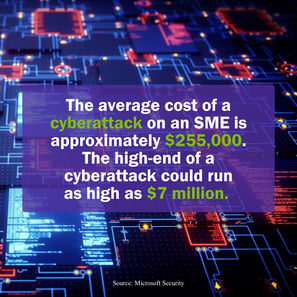 Research by Microsoft Security estimates the average cost of a cyberattack on an SME is approximately $255,000. The high-end of a cyberattack could run as high as $7 million. Those numbers may include investigation and recovery costs, lost data and productivity, reputational harm, fines, missed business opportunities, and even ransom payments. For many logistics companies, that kind of loss is catastrophic. What is your average profit margin? How much additional revenue would you need to generate to make up for this type of out-of-pocket loss?
And the financial impact is just the beginning. Industry groups and cybersecurity organizations frequently cite research indicating that a significant percentage of small businesses fail within months of a severe cyber incident, particularly when they lack cyber insurance and a formal response and business continuity plan. While exact percentages vary, some studies estimate that as many as 60% of SMEs shut down within six months of a cyberattack.
The Hidden Costs No One Budgets For
Unlike cargo theft, cyber incidents create cascading losses that extend well beyond the initial event:
• Reputational damage that erodes trust with customers, carriers, and lenders
• Ransom payments or extortion demands tied to locked systems or stolen data
• Regulatory fines and legal costs, especially when customer or employee data is compromised
• Lost customers and revenue when operations are disrupted or credibility is questioned
• Operational setbacks, including days or weeks of system downtime and billing delays
Unlike a stolen load, these losses are not isolated. They ripple through every part of the organization.
Why a Cyber Risk Management Plan Matters—Especially in Logistics
Cyber Insurance does more than reimburse losses. Proper coverage can include access to:
• Pre and post-incident response plans
• System scans
• Incident response teams
• Forensic investigations
• Legal support
• Regulatory notifications
• Data recovery
These services are all critical for survival after an attack. Most importantly, a solid Cyber Risk Management plan buys time. Time to recover. Time to communicate clearly with customers. Time to keep the business operating. Cargo fraud threatens the shipments you handle. Cyber risk can threaten your entire company.
The Bottom Line
The logistics industry is right to take cargo fraud seriously, but there may be existential threats already inside your own systems. Cybercrime doesn’t just steal freight. It can steal data, cash flow, credibility, and, in many cases, your business's future.
The surprising truth about a comprehensive Cyber Risk Management Plan is simple: you’re far more likely to survive a cyberattack with it than without it. And in today’s logistics environment, the question is no longer if an attack will happen, but whether your business is prepared to withstand it. Your choice is to either let the pace of fraud dictate your risk or be prepared and create your own plan of attack.
GET UPDATES

The Quest Newsletter is designed to provide critical information in the transportation industry. Avalon Risk Management is not responsible for the accuracy or reliability of information contained in articles. The reader/user assumes all risk in the use of such information.